Friday, November 2, 2012

Can you help?


Wow.  We are still plugging along.  Most of our patients are either non-releasable and we are working on placement for them, or we are determining if they can/should be released.  This time of year is always this way.  Enough time has passed that patients that came in earlier in the year with severe problems are finally being evaluated or have been.
Our eagle from the last post, Mesa, was released at Hogans Pass in central Utah.  We have released eagles at this area before.  It's a beautiful place, with high alpine mountains, over 9,000 feet at the summit and contrasting red-rock deserts.  The beauty of Utah.  I hope Mesa will thrive there and in the next couple of years, find a mate.


Our one-eyed Swainsons hawk, a first year male, will be going into an education  program in New York.  The paperwork is in the process, so he will become an educational embassador for his species.  We really struggled with this decision as he is an amazing killer of prey, but his inability to land on his perches perfectly, every time, made our decision.  This would not be acceptable in the wild and would put him in extreme danger, drawing the attention of other predators.


We took in another little Screech owl, this one from the Salt Lake County area of Utah.  Talk about a messed up wing.  Now that some of the swelling and bruising is gone, it's apparent that there are no broken bones in those areas.  We still have one area of concern so it's guarded optimism at this point.  Once the swelling goes down there, I will get her an x-ray to confirm things are good or not.  She's such a cutie.  She was named Mojo by the finders.  We hope to return her to that area should things work out for her.

Our Ferruginous hawk, Layla, is doing very well.  I put her into our large flight cage today, mainly to see what she can and can't do.  I'm positive she will be non-releasable at this point, but now that she is self feeding,  we can work on finding her that perfect place to live out her days.

 If she had continued not eating and we had to force her twice daily, that is not an option for an educational bird.  They have to be self feeding.  It's about quality of life.  She has gone from not expected to last the night, to a thriving, fiesty girl.  She showed all of us!  The mass she had develop as a result of the trauma that brought her in to us is still there, but not growing any longer and is not causing her respiratory distress, as it was starting to.  We are so happy for her.


We are releasing Honey, the Great Horned owl, this weekend near Genola, Utah.  Remember her?  The owl that was caught in a barbed wire fence near the Colorado border and the finder 'cut' her off the fence instead of cutting the fence?  She went through several cold-laser therapy treatments here in Price and had only natural honey used on her wound.

 She healed very well with absolutely no indication of her prior injury.  She's been hanging out, regrowing her feathers in that area and then, exercising her wings in the flight.  Today, Connie drove her back to Utah county to my other volunteer Jim, and he will release her in the next few days.

Enjoy the pictures.  If anyone knows of someone in a position that can help us with a van, whether it be a donated van or someone that works at a dealership that can possibly get a used van donated, we are desperate.  And considering we are picking up most of our patients and they come from extremely rural areas, we need one that won't leave us stranded in the middle of nowhere with a patient in trouble.  We can provide a tax number for this donation.  Without a good van, we can only rely on DWR (our states wildlife agency) to get our patients to us and believe me, that won't work.  Our people are covering huge areas of the state and frequently need me to intervene as they cannot.  So you see our dilemma.  It's a great cause.

Thanks everyone,
Debbie

Wednesday, October 17, 2012

I sure love this time of year..........

Don't you just love Fall?  The colors are spectacular, animals are on the move and preparing for winter.  The coolness in the air feels wonderful.  It's my favorite time of year.  There is also a sense of urgency in the air with all the changes happening.  So too, our animals in rehab feel that as well.  It's difficult to watch those that cannot go with their urges, natures call to move.  We move those that we can, but some, will have to spend the winter with us.  This is the way it is for all rehabbers working with migratory species.  We do what's right for the patient, regardless.  At least that's what a good rehabber does.

We have been able to release a few of our patients;  a Swainsons hawk  that became orphaned after a wildfire.  She hung out here, with other Swainsons' hawks until she was ready and proved to be a proficient killer.  We also released an American Kestrel that had a head injury and trauma to a wing.  We took him back to Moab, Utah and let him go. 
Male American Kestrel from Moab, Utah
 
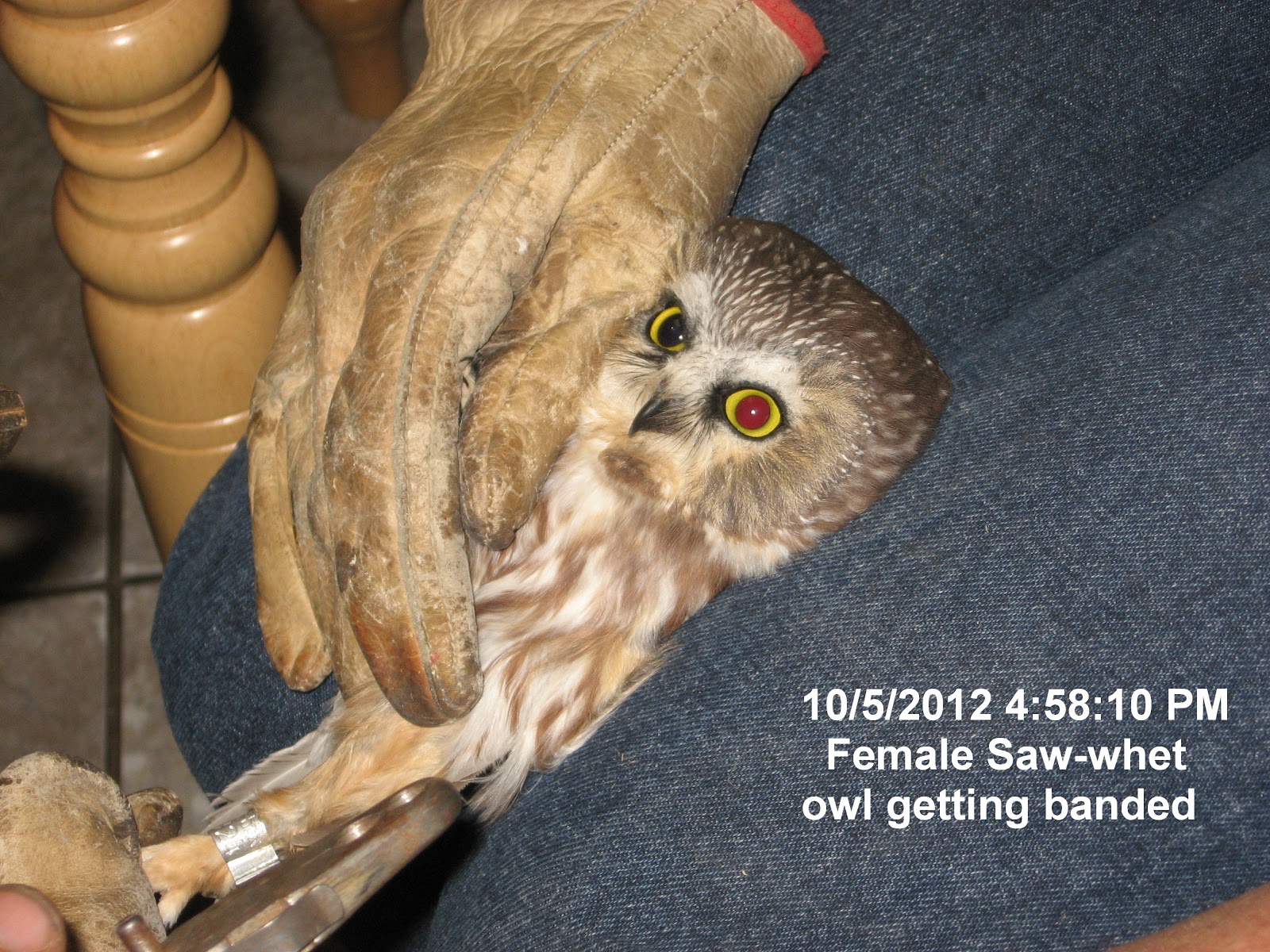
Our Short-eared owl and Saw-whet owl were also successfully released. 

Saw-Whet owl release at Jeremy Ranch, Utah


We have a Swainsons hawk that had a broken leg and his cast has now been removed and he is doing quite well.  I have a volunteer checking a spot that is a staging area for other Swainson hawks to see if another group has come through and is resting there for a few days.  If so, I may drive him down there so he can migrate with the group.
Male Swainsons hawk with only one eye.

 
 I've determined our Swainsons hawk that came in missing an eye, cannot go back to the wild as he occassionally misses his perches.  This wouldn't be good for survival out there.  It's hard enough and when you've got a problem like that, well, it just isn't good.


We are anticipating release of one of our Golden eagles,
 Mesa.  He has now been banded with a Federal band and is currently kill-testing.  So far, so good.  He's very strong and tenacious.  Just what I like to see in an eagle.  We are still working on a transfer for Cisco, another of our Golden eagles that surgery couldn't help.  The surgery was done, but calcification around the injury prevents the elbow joint from moving properly, now grounding him.  He will be going to live in Oklahoma with the Iowa Nation.  Check out their wonderful website.  http://www.iowanation.org/

They have several of our non-releasable eagles, both Goldens and Balds. 

We had another little Saw-whet owl come in, but that little angel did not survive.  He had a traumatic brain injury and died as a result.  These little angels are so delicate, yet hardy at the same time.  There is hardly anything to them, weighing less than 100 grams.  Our little male weighed just 60 grams, females weighing more of course.


We also had another Ferruginous hawk come in from the same area our other Ferruginous came from, around the Four-corners area of Utah.  The second one had secondary lead poisoning.  My God, why can't people get with the program.  These deaths are totally preventable.  These hayseeds around here continue to use lead based ammunition.  They go out shooting animals, just to kill something and then, they leave their poor bodies, now filled with lead, just laying there, not attempting to bury them at all, so any predator that comes by, now has an easy meal, that will most certainly kill them.  It takes anywhere from a couple of days to a few days, depending on the species eating the remains and how much they have eaten.  It's one of the most horrific deaths you can imaging.  There are many different types of ammunition that they could use that won't cause this, since they feel they MUST kill things, but they don't buy this alternative since it's a few pennies more.  It's disgusting. It doesn't matter the repercussions, because for these idiots, there are none.  We rehabilitators are the ones who deal with the aftermath and see the pain and suffering and death.  This Ferruginous did not survive.  We started the treatment immediately, even before blood was pulled to run a lead level, but it was not enough to save him.  The damage was too extensive.  He fought a good fight but in the end, the lead won.  This species is listed as a species of concern in Utah, so you would think  our wildlife agency would have an interest in these cases, but, not really.  It's not something you can hunt in Utah and therefore, not sell a permit for killing it, so it's not really a concern.  Sad, but true.

Debbie
 

Thursday, September 27, 2012

Busy Time of Year and the weather is pushing us along

Fall is certainly upon us.  It's early, like everything this year.  Rehab has been very effected by this from double and triple clutches of birds and strange storms and many, many fires this year.  Utah already has had it's first snow of the year and the winds are giving us grief.  The pics below are of a release of two American Kestrels and two Barn owls.  My grandson Joshua was finally able to release his first 'big' bird.


We have been able to release a few of our patients with a particular focus

on getting out one of our Swainsons' hawks in time for their migration.


  Thankfully, one of my volunteers found a staging area and she was welcomed into the group.  We still have two more Swainsons, but I don't know if/when they will be released.  One has a missing eye, well, there is something there, but he is non-visual and the other came in with a broken right leg.   The pic says RTHA, but he is a Swainsons.   He will get his cast off in about a week or so.  Those two may be wintering over with us.


We are trying to get our Saw-Whet owl in the mood to kill, but for now, she's content with 'Club Debbie' and the in-room-services we provide.


We have a Golden Eagle, Mesa, that is ready to kill-test and hopefully will soon be ready to be released.


We also released a Sharp-Shinned hawk that came in injured and emaciated.  Once the fracture healed, we determined that this bird could fly well enough to be set-free, so we taught her that mice are also a good food source and she learned that well and quickly.  Sharpies generally are bird eaters, so the added food source and ability to kill it will most certainly increase her chances in the wild.  We hope she does well.


We are kill-testing our Short-eared owl as well.  Apparently she is not as thrilled at this prospect as our little Sharpie was.  Oh well, time will tell. 


We took in another Kestrel, this one from Moab, Utah after being struck by a man riding a dirt bike there.  He's doing well and should be released soon.  He came in with a concussion and a slight wing droop in his left wing, although I can't find a fracture anywhere in that wing.  Hoping it may be a tissue injury.

Enjoy the pic's.  Remember everyone that every donation made up until the 1st of  November will be doubled when going to our veterinarian in Utah county, Dr. Jay Ipsen.  Donations during this time will be particularly beneficial since they will be doubled and the bill we still have for the year 2011 is quite large and will be applied to it.  Thank God he's a patient man.  I can't imagine not being able to provide the necessary medical care that Dr. Ipsen provides, such as complex surgeries and x-rays for our patients.  These things take money and while we rehabilitators work for free, taking no money at all, our vets are providing these services and a great deal is donated, but not all so these bills pile up without donations to cover them.  Please go to our PayPal button and help the wildlife if you can.
Thanks,


Debbie

Monday, September 10, 2012

Very busy for this time of year....................

This post is going to be about our little Night Hawk.  We get several of these little guys in each year, most are hit by vehicles at dusk and night while they are chasing insects that are attracted to the headlights from our cars.  These little predators are amazing creatures.  They nest on the ground, so they have what is referred to as 'cryptic plumage'.  They blend very well.  They hunt in groups of other Night Hawks and bats as they are after the same food source.  If you have ever gone to a business at night that has a large parking lot with those hideously bright lights, no doubt you've seen these guys and their cousins hunting.  You may have thought they were bats, but these are larger than are most common bats and the wings are totally different.  The Night Hawks, members of the Night Jar family which includes Poor Will's and Whippoorwill's, have a white band on each wing that can be seen in flight.  They are very fast and agile, so when they get injured, it's usually not a good outcome as their little bones are too small for most surgical attempts and they would never withstand being anesthetized and would die in the process, so it's rare to have a good outcome with these angels.
We currently have one here in our care, that we are hoping will be released.  I'm including a video during a feeding to show you their amazing mouths.  These little ones hunt by opening their huge mouths and flying through a group of insects and then just swallowing what they caught.  Similar to baline whales and how they hunt.  So a bit of education and a video.  Learn more about Night Jar's and how they live.  You are sure to be surprised!
                                                       Enjoy!  Debbie


Feathered brothers and sisters, you came to us broken and as you bled…….we saw you desperate, dehydrated, desiccated, diseased, distressed, emaciated, famished, frayed, frightened, helpless, hungry, ragged, ravenous, shaken, shocked, shot, sickly, stressed, stunned, tattered, thirsty, traumatized, torn, weary and wounded. Defiantly, you stood us off with your last breath as we tried to tend to you. We saw you come in as cute, naked, fuzzy, cuddly youth, as mischievous, defiant adolescents, as fierce, regal rulers of the sky and as cunning, maimed elders whose time on earth was almost done. You endeared yourselves to us, bit us, charmed us, footed us, delighted us, hissed at us, talked to us, mantled at us, and graced us with your presence.

Some of you mended and were able to go on your way, never looking back. Some of you were injured in ways that prevented you from going, so you stayed with us to teach us…….And we came to love you. Others were too far gone, and you went home - where you fly free from pain with the Great One. All of you have touched us, and we are changed because of you.

used with permission by Arlene Powers


Get a playlist! Standalone player Get Ringtones