Don't you just love Fall? The colors are spectacular, animals are on the move and preparing for winter. The coolness in the air feels wonderful. It's my favorite time of year. There is also a sense of urgency in the air with all the changes happening. So too, our animals in rehab feel that as well. It's difficult to watch those that cannot go with their urges, natures call to move. We move those that we can, but some, will have to spend the winter with us. This is the way it is for all rehabbers working with migratory species. We do what's right for the patient, regardless. At least that's what a good rehabber does.
We have been able to release a few of our patients; a Swainsons hawk that became orphaned after a wildfire. She hung out here, with other Swainsons' hawks until she was ready and proved to be a proficient killer. We also released an American Kestrel that had a head injury and trauma to a wing. We took him back to Moab, Utah and let him go.
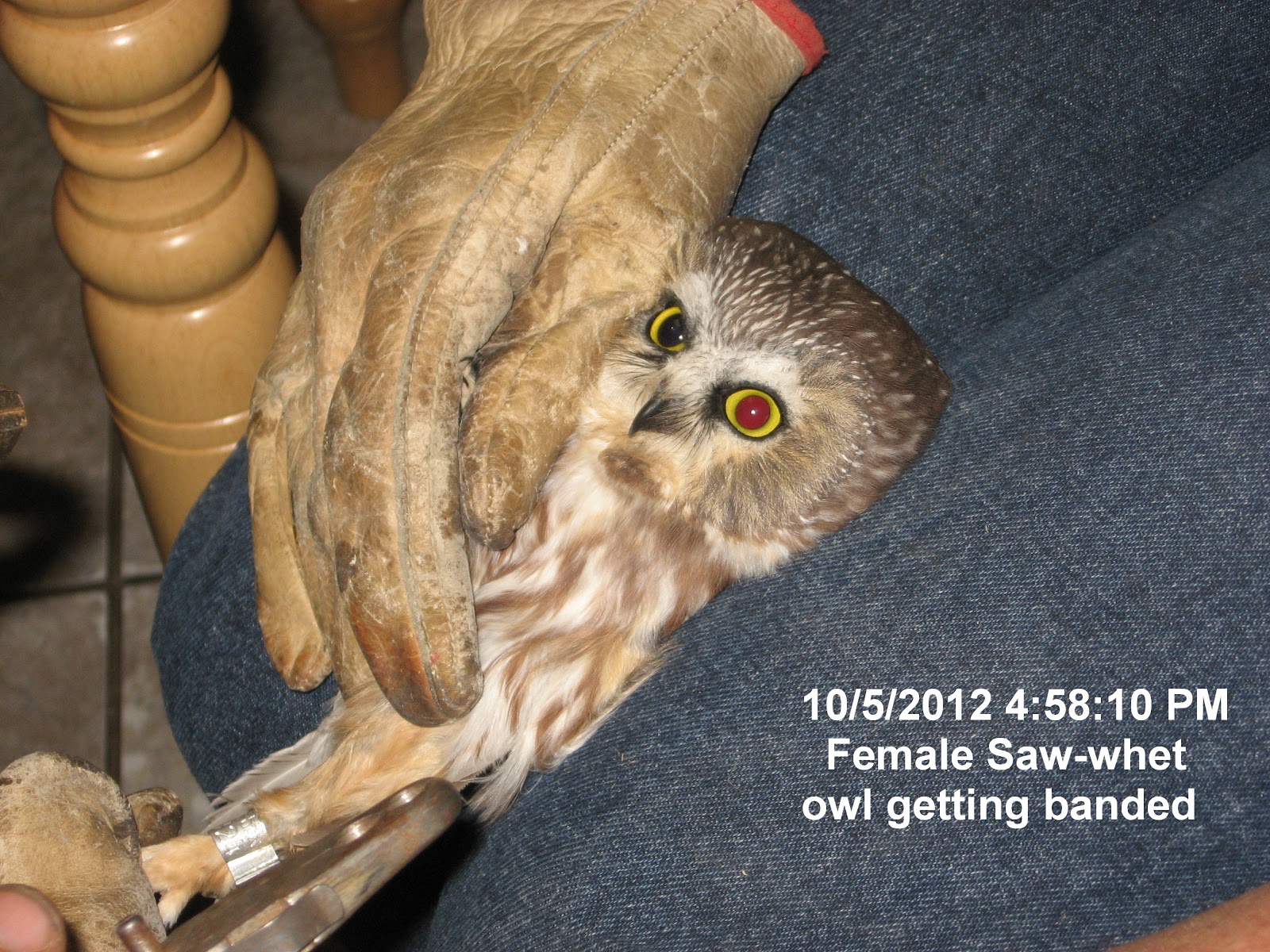
Our Short-eared owl and Saw-whet owl were also successfully released.

We have a Swainsons hawk that had a broken leg and his cast has now been removed and he is doing quite well. I have a volunteer checking a spot that is a staging area for other Swainson hawks to see if another group has come through and is resting there for a few days. If so, I may drive him down there so he can migrate with the group.
I've determined our Swainsons hawk that came in missing an eye, cannot go back to the wild as he occassionally misses his perches. This wouldn't be good for survival out there. It's hard enough and when you've got a problem like that, well, it just isn't good.
 We are anticipating release of one of our Golden eagles,
Mesa. He has now been banded with a Federal band and is currently kill-testing. So far, so good. He's very strong and tenacious. Just what I like to see in an eagle. We are still working on a transfer for Cisco, another of our Golden eagles that surgery couldn't help. The surgery was done, but calcification around the injury prevents the elbow joint from moving properly, now grounding him. He will be going to live in Oklahoma with the Iowa Nation. Check out their wonderful website. http://www.iowanation.org/
They have several of our non-releasable eagles, both Goldens and Balds.
 We had another little Saw-whet owl come in, but that little angel did not survive. He had a traumatic brain injury and died as a result. These little angels are so delicate, yet hardy at the same time. There is hardly anything to them, weighing less than 100 grams. Our little male weighed just 60 grams, females weighing more of course.
 We also had another Ferruginous hawk come in from the same area our other Ferruginous came from, around the Four-corners area of Utah. The second one had secondary lead poisoning. My God, why can't people get with the program. These deaths are totally preventable. These hayseeds around here continue to use lead based ammunition. They go out shooting animals, just to kill something and then, they leave their poor bodies, now filled with lead, just laying there, not attempting to bury them at all, so any predator that comes by, now has an easy meal, that will most certainly kill them. It takes anywhere from a couple of days to a few days, depending on the species eating the remains and how much they have eaten. It's one of the most horrific deaths you can imaging. There are many different types of ammunition that they could use that won't cause this, since they feel they MUST kill things, but they don't buy this alternative since it's a few pennies more. It's disgusting. It doesn't matter the repercussions, because for these idiots, there are none. We rehabilitators are the ones who deal with the aftermath and see the pain and suffering and death. This Ferruginous did not survive. We started the treatment immediately, even before blood was pulled to run a lead level, but it was not enough to save him. The damage was too extensive. He fought a good fight but in the end, the lead won. This species is listed as a species of concern in Utah, so you would think our wildlife agency would have an interest in these cases, but, not really. It's not something you can hunt in Utah and therefore, not sell a permit for killing it, so it's not really a concern. Sad, but true.
Debbie
We have been able to release a few of our patients; a Swainsons hawk that became orphaned after a wildfire. She hung out here, with other Swainsons' hawks until she was ready and proved to be a proficient killer. We also released an American Kestrel that had a head injury and trauma to a wing. We took him back to Moab, Utah and let him go.
 |
| Male American Kestrel from Moab, Utah |
 |
| Saw-Whet owl release at Jeremy Ranch, Utah |
We have a Swainsons hawk that had a broken leg and his cast has now been removed and he is doing quite well. I have a volunteer checking a spot that is a staging area for other Swainson hawks to see if another group has come through and is resting there for a few days. If so, I may drive him down there so he can migrate with the group.
 |
| Male Swainsons hawk with only one eye. |

Mesa. He has now been banded with a Federal band and is currently kill-testing. So far, so good. He's very strong and tenacious. Just what I like to see in an eagle. We are still working on a transfer for Cisco, another of our Golden eagles that surgery couldn't help. The surgery was done, but calcification around the injury prevents the elbow joint from moving properly, now grounding him. He will be going to live in Oklahoma with the Iowa Nation. Check out their wonderful website. http://www.iowanation.org/
They have several of our non-releasable eagles, both Goldens and Balds.
 We had another little Saw-whet owl come in, but that little angel did not survive. He had a traumatic brain injury and died as a result. These little angels are so delicate, yet hardy at the same time. There is hardly anything to them, weighing less than 100 grams. Our little male weighed just 60 grams, females weighing more of course.
 We also had another Ferruginous hawk come in from the same area our other Ferruginous came from, around the Four-corners area of Utah. The second one had secondary lead poisoning. My God, why can't people get with the program. These deaths are totally preventable. These hayseeds around here continue to use lead based ammunition. They go out shooting animals, just to kill something and then, they leave their poor bodies, now filled with lead, just laying there, not attempting to bury them at all, so any predator that comes by, now has an easy meal, that will most certainly kill them. It takes anywhere from a couple of days to a few days, depending on the species eating the remains and how much they have eaten. It's one of the most horrific deaths you can imaging. There are many different types of ammunition that they could use that won't cause this, since they feel they MUST kill things, but they don't buy this alternative since it's a few pennies more. It's disgusting. It doesn't matter the repercussions, because for these idiots, there are none. We rehabilitators are the ones who deal with the aftermath and see the pain and suffering and death. This Ferruginous did not survive. We started the treatment immediately, even before blood was pulled to run a lead level, but it was not enough to save him. The damage was too extensive. He fought a good fight but in the end, the lead won. This species is listed as a species of concern in Utah, so you would think our wildlife agency would have an interest in these cases, but, not really. It's not something you can hunt in Utah and therefore, not sell a permit for killing it, so it's not really a concern. Sad, but true.
Debbie